Complete Guide to Marble Floor Maintenance and Professional Restoration
Marble is the top choice for high-end commercial spaces and luxury hotels. However, its microporous nature makes it highly vulnerable to dirt and moisture. Therefore, establishing a scientific system for marble floor cleaning and maintenance is crucial. As a stone care professional, you need reliable methods to protect these surfaces.
This article will provide you with effective strategies to help you better clean and maintain marble floors, covering everything from daily protection to advanced restoration techniques. By using the correct methods and high-quality diamond polishing pads for stone, you will deliver impeccable flooring results to your clients.
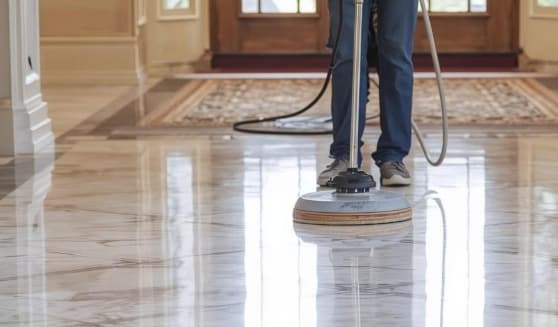
Daily Strategies to Clean and Maintain Marble Floors
To maintain the stone's natural gloss, preventing scratches and controlling moisture must be top priorities. Moisture easily penetrates the pores within the stone. As a result, it causes long-term damage and discoloration.
Daily Protection Checklist:
1. Minimize Water Use: We recommend using an electrostatic dust pusher or a slightly damp mop for daily surface cleaning. Never allow large amounts of standing water on the surface.
2. Pre-Treatment for Stain Prevention: You must protect the stone from spills. Apply a professional-grade waterproof treatment immediately after installation.
3. Prevent Physical Scratches: Sand and grit from shoes destroy the polish. Therefore, you must use dust pushers frequently in high-traffic areas.
4. Move Objects Safely: Never drag heavy items directly across the floor. Instead, you must use padded carts or place soft cardboard underneath furniture.
Professional Marble Floor Maintenance Methods
Over time, routine cleaning cannot prevent natural surface wear. Therefore, you must employ professional marble floor maintenance techniques to restore the stone's hardness, density, and shine.
Why Waxing is Obsolete
More than 15 years ago, waxing was the industry standard. However, it is now entirely obsolete. Wax easily absorbs dirt and moisture. Furthermore, the wax layer is soft and hides the natural gloss of the stone. Eventually, the labor costs to strip, clean, and re-apply wax become too expensive for contractors.
Crystal Surface Reconstruction
Today, crystallization is the most scientific and widely used maintenance method. You use a heavy mirror maintenance machine weighing over 65 kg. The machine pairs with specialized polishing pads. Next, the friction generates heat. This heat causes chemical materials to bond directly with the stone's surface.
Consequently, this process creates a harder, brighter crystalline layer. It improves wear resistance without closing the site. Foot traffic can resume immediately, making it highly cost-effective for commercial managers.
Paste Solidification (Sealing Glaze)
This technique upgrades the traditional crystallization process. You use a paste containing nano-molecules, water-soluble resins, and silicon molecules. A low-speed machine rubs these components deep into the stone's pores.
While this method offers excellent filling properties, it has very low grinding power. Thus, you must ensure the marble already has a perfectly smooth and leveled surface before application.
Liquid Curing Agents for Deep Refurbishment
For severely weathered or deeply scratched floors, standard surface care is not enough. You must perform a deep refurbishment. This involves coarse grinding, fine grinding, polishing, and final crystallization. During the grinding process, you apply liquid hardeners. These hardeners infiltrate the stone and strengthen the loose structural integrity.
Comparing Marble Restoration Techniques
To help you quickly select the best solution for your next project, please refer to the comparison table below. This ensures you deliver the highest value to your clients while maximizing your team's efficiency.
| Maintenance Process | Best Application Scenarios | Cost and Construction Efficiency |
|---|---|---|
| Wax Maintenance | Not recommended (outdated technology) | High long-term cost, low efficiency |
| Crystallization | Regular maintenance, high-traffic commercial spaces | Extremely cost-effective, zero downtime |
| Paste Solidification | Smooth floors needing extra gloss and pore filling | Medium cost, requires good initial surface |
| Deep Renovation | Severely damaged, scratched, or weathered stone | High initial cost, permanent structural fix |
Choosing the Right Diamond Tools for Stone Care
Perfect marble floor maintenance always starts with a flawless, scratch-free base. Whether you perform crystallization or paste sealing, the quality of your initial grind dictates the final result. Therefore, you must use premium abrasives to prep the floor.
As a globally renowned polishing tool enterprise, Z-LION provides tools built for maximum efficiency. Our advanced flexible diamond abrasive tools quickly remove aging layers with minimal tool wear. Consequently, your team works faster and achieves a superior finish. Furthermore, our eco-friendly manufacturing aligns with strict ESG standards for major commercial building projects.
Elevate the Quality of Your Stone Care Projects Today
Proper marble floor maintenance not only protects your clients' investment but also fully reveals the stone's natural beauty. By combining daily cleaning with advanced crystallization technology, you can effectively prevent serious defects such as weathering, dusting, and pitting. Finally, using high-quality polishing tools ensures a flawless finish every time.If you wish to optimize workflows and reduce the costs, request a quote for polishing tools today and consult directly with our technical experts for a customized solution.
Frequently Asked Questions
How often should you perform crystallization on marble floors?
It entirely depends on the foot traffic. For high-traffic commercial spaces, you should perform crystallization monthly. In contrast, low-traffic residential spaces may only need it once every six to twelve months.
Can you use acidic cleaners to clean and maintain marble floors?
No. You must never use acidic cleaners. Acid quickly etches the calcium carbonate in the marble. As a result, it destroys the polished surface instantly. Always use pH-neutral stone cleaners.
What is the main difference between polishing and crystallization?
Polishing uses diamond abrasives to physically smooth the stone and remove scratches. Alternatively, crystallization is a chemical reaction. It creates a hard, protective micro-layer directly on top of the newly polished surface.
-
Online service
-
Official wechat account

-
QQ:844389055
-
E-mail:VIP@zliontools.com
Online Message
Please feel free to give your inquiry in the form below. We will reply you in 24 hours.