Working Principle and Technical Analysis of Diamond Wire Saw
Diamond wire saws have become essential tools across a wide range of industries, particularly in stone processing, construction, and precision cutting. Their unique design and advanced technology enable them to cut a wide range of materials efficiently and with high precision. This article explores the core structure, material properties, and operating principles of diamond wire saws.
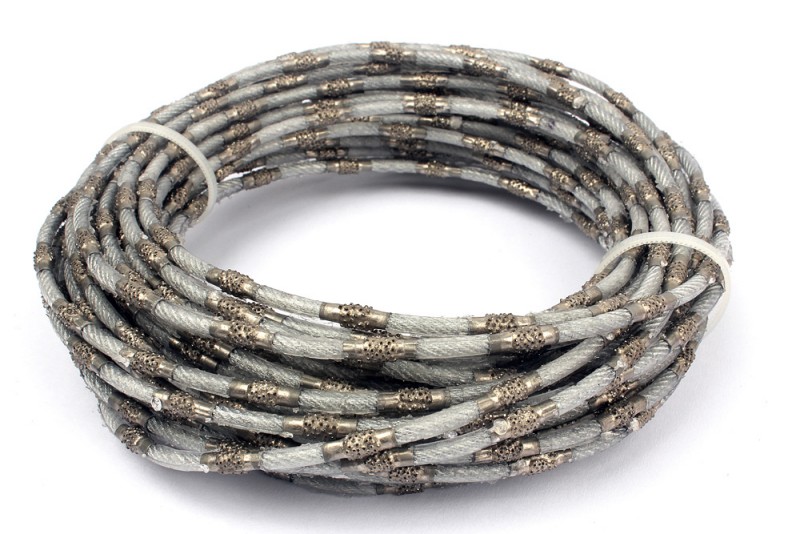
Core Structure and Material Properties
A diamond wire saw consists of three key components that work together to achieve effective cutting:
1. High-strength steel wire core
The core wire of a diamond wire saw is made of high-strength steel wire, typically galvanized or alloy steel strands. The core diameter ranges from 8 to 11 mm, enabling it to withstand significant tensile forces, typically 3 to 5 tons. This strength is crucial to maintaining the integrity of the saw during operation, especially when cutting tough materials.
2. Diamond beads
Embedded along the wire are diamond beads—cylindrical alloy matrices containing approximately 30-50% diamond particles. The beads are spaced 10 to 15 centimeters apart and each contains approximately 2 carats of synthetic diamonds. These diamond particles, with a Mohs hardness of 10, are crucial for cutting hard materials because they leave microscopic scratches in the surface.
3. Connection
Special injection-molded connectors ensure the wire saw forms a closed loop. This design enables the wire saw to run at high speeds, typically 25 to 40 m/s. The closed loop is crucial for maintaining tension and ensuring smooth operation during cutting.
Dynamic Cutting Mechanism
The cutting action of a diamond wire saw has a complex combination of mechanisms that increase its efficiency:
1. Complex combined cutting actions
Micro-scratching: Diamond particles create microscopic scratches on the material surface through friction. This initial action prepares the material for further cutting.
High-frequency impact: The saw blade rotates at high speed, producing thousands of collisions per minute. This high-frequency impact induces fatigue fracture at the grain boundaries of the material, making it easier to cut.
Cooling system
In order to maintain the best cutting conditions, we use a cooling system. The functions of cooling water are as follows:
Debris removal: Water flushes away debris generated during the cutting process, preventing it from interfering with the cutting action.
Reduces thermal damage: By keeping the temperature difference of the cutting surface within 50°C, the cooling system minimizes thermal damage to the saw and the material being cut.
2. Adaptive working mode
The diamond wire saw is equipped with adaptive working modes that enhance its performance:
Tensioning system
The tensioning system keeps the wire at a constant tension of 200 to 400 kg. This constant tension is essential to ensure stable cutting and prevent wire breakage during operation.
Intelligent control system
The intelligent control system automatically adjusts the feed speed according to the hardness of the material being cut. For example:
Marble: The feed rate is usually set at 3-5 m²/h.
Granite: Adjust the feed rate to 0.8-1.5 m²/h.
This adaptability allows the diamond wire saw to optimize its cutting efficiency based on specific material properties.
Self-grinding beads
The self-sharpening diamond beads ensure consistent cutting efficiency throughout operation. As the beads wear, new diamond particles are exposed, maintaining the saw blade’s cutting performance over time.
Typical Application Scenarios
1. Mining
In the mining industry, diamond wire saws are widely used due to their ability to achieve vertical cutting depths of up to 30 meters. This capability significantly increases block yield by approximately 40%, making it a valuable tool for mining high-quality blocks and minimizing waste.
Efficiency: The precise cutting of diamond wire saws allows for better material utilization and reduces stone loss during the mining process. This efficiency is crucial to maximizing the profitability of mining operations.
2. Restoration of ancient buildings
Diamond wire saws are also used in the restoration of ancient architecture, such as the marble structures of the Acropolis in Athens. The minimally invasive cutting technique used by these saws allows for precise extraction of marble with an accuracy of just 0.3 mm.
Conservation: This level of precision is essential to protecting the integrity of historic buildings, ensuring that restoration work does not harm the original materials. The ability to cut with such precision helps maintain the aesthetic and structural qualities of historic buildings.
3. Nuclear power plant dismantling
In the field of nuclear power plant demolition, diamond wire saws play a vital role in the controlled decomposition of radioactive contaminants. These saws can effectively cut concrete walls up to 1.5 meters thick while minimizing the release of hazardous materials.
Safety: The precision and control provided by diamond wire saws ensures that demolition operations can be carried out safely and efficiently, reducing the risk of exposure to radioactive materials during the demolition process.
Future Development Trends
As technology continues to advance, several trends are emerging that promise to improve the performance and sustainability of diamond wire saws:
1. Nanodiamond coating technology
One of the most promising developments is the introduction of nano-diamond coating technology, which can extend the life of diamond wire saw beads to an impressive 300 hours. This innovation not only increases the durability of the saw, but also reduces the frequency of replacement, thereby reducing operating costs and reducing material waste.
2. 5G Remote control system
The integration of 5G technology will revolutionize mining operations by enabling unmanned cutting processes. Remote control systems will allow operators to remotely control diamond wire saws, improving safety and efficiency in hazardous environments. This technological advancement will enable more precise control of cutting operations, reducing the risk of accidents and increasing overall productivity.
3. Environmentally friendly biodegradable coolant
With the increasing emphasis on sustainable development across all industries, the development of environmentally friendly, biodegradable coolants for diamond wire saws is gaining increasing attention. These coolants will minimize the environmental impact of cutting operations while maintaining effective cooling and lubrication during the cutting process. The use of biodegradable materials aligns with global efforts to reduce pollution and promote environmentally friendly practices in industrial production.
-
Online service
-
Official wechat account

-
QQ:844389055
-
E-mail:VIP@zliontools.com
Online Message
Please feel free to give your inquiry in the form below. We will reply you in 24 hours.