Advantages of Diamond Abrasive Belts for Grinding Glass Edges
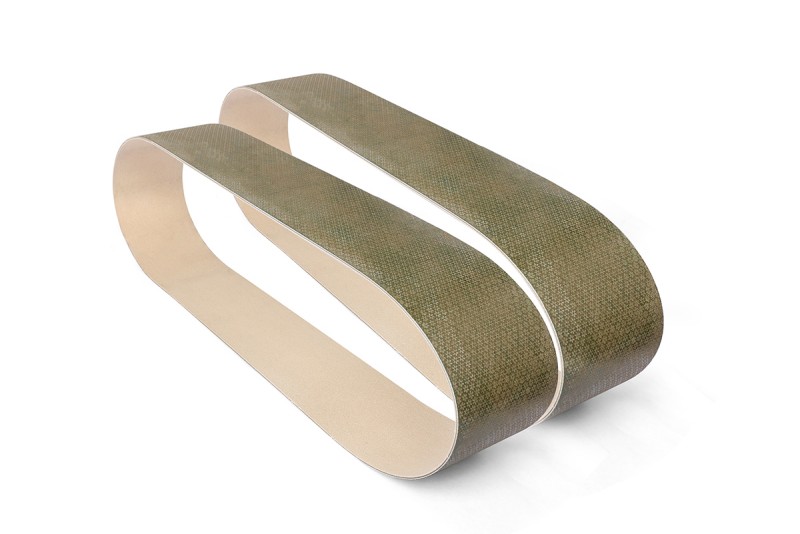
Diamond abrasive belts have shown significant advantages in glass edge processing (such as chamfering, polishing, and deburring), and are particularly suitable for high-precision, complex curved surfaces, and mass production scenarios. It combines the wear resistance of diamond superhard materials with the characteristics of flexible processing of abrasive belts, becoming a core tool to replace traditional grinding wheels and ordinary abrasive belts. The following is a detailed analysis of its core advantages:
1. Processing Quality Advantages: High Finish and Little Damage
Improved surface finish
One of the most significant benefits of diamond abrasive belts is their ability to achieve an exceptional surface finish.
High grinding capability: Diamond abrasives can reach a particle size of more than #3000, which can achieve ultra-fine polishing. This capability is essential for applications that require mirror-like polishing effects, such as optical glass and high-end electronic components.
Evenly distributed: Diamond particles are evenly distributed on the abrasive belt, ensuring uniform contact with the glass surface. Combined with the elastic pressure of the flexible substrate, this design helps to effectively mirror polish the glass edge.
Ra value: Surface roughness (Ra) values of ≤0.1μm meet the stringent requirements of high-end applications. This finish often eliminates the need for subsequent polishing, simplifying production processes and reducing overall processing time.
Edge chipping and microcrack control
Another significant benefit of diamond abrasive belts is their ability to minimize edge chipping and control micro-cracks during the grinding process.
Flexible contact: Unlike rigid tools such as traditional grinding wheels, diamond abrasive belts offer a flexible contact surface. This flexibility allows the belt to adapt to the contours of the glass, thus reducing impact force on the edge.
Reduce edge chipping: When using diamond belts, the edge chipping width is ≤ 0.05 mm, which is much lower than the 0.1-0.2 mm chipping usually produced by traditional grinding wheels. The reduction of chipping is critical to maintaining the integrity of the glass edge.
Microcrack prevention: By minimizing the impact on the glass edge, the diamond belt helps avoid the formation of microcracks, which can reduce strength. This control of edge quality is essential to ensure the durability and reliability of the finished product.
Improved product yield: Improved processing quality and reduced damage have resulted in a product yield of over 98%. This improvement is particularly beneficial in large-scale production scenarios where efficiency and quality are critical.
2. Processing Efficiency Advantage: High-Speed Continuous Operation
Double the grinding efficiency
One of the most striking advantages of diamond abrasive belts is their excellent grinding efficiency.
High line speed: The diamond belt line speed can reach 30-50 m/s, which can quickly process the glass edge. Such a high speed allows rough grinding and fine polishing to be completed in one go, significantly shortening the time required for each operation.
Time savings: For example, a diamond belt only takes 10 seconds to finish a 1 meter long glass edge. In contrast, a conventional silicon carbide belt might take 30-50 seconds to achieve a similar result. This significant reduction in processing time means increased productivity and efficiency in a manufacturing environment.
Continuous processing without downtime
Another significant benefit of diamond abrasive belts is their ability to facilitate continuous processing, which is particularly beneficial in large-scale production scenarios.
Extra-long belts: Diamond belts are usually supplied in rolls with lengths ranging from 50 to 100 meters. Extra-long belts extend service life and eliminate the need for frequent tool changes, thereby minimizing downtime and increasing operational efficiency.
Automatic belt feeding system: With the automatic belt feeding system, the diamond belt can run continuously for hours. This feature is ideal for high-volume production environments, such as the manufacture of automotive sunroofs and building curtain walls, which require continuous, uninterrupted processing.
3. Process Adaptability Advantages: Complex Curved Surfaces and Thin Glass Processing
Adapt to contours of special shapes
One of the outstanding features of diamond abrasive belts is their flexibility, which allows them to adapt to the unique contours of various glass shapes.
Conforms to curved surfaces: Diamond abrasive belts can easily conform to the curvature of complex glass surfaces, such as 3D mobile phone cases and car windshields. This adaptability ensures uniform grinding across the entire surface, resulting in a consistent finish.
Avoid uneven edges: Conventional grinding wheels are hard and can easily cause uneven edges or over-grinding, especially on curved surfaces. The flexibility of diamond abrasive belts reduces this risk, allowing precise control of the grinding process. This is essential to maintaining the aesthetic and functional integrity of the glass.
Improved precision: The ability to adapt to irregular contours not only improves surface quality, but also the overall precision of the grinding process. This is particularly important in applications with tight tolerances, such as optical glass and high-end electronic components.
Effective processing of thin glass
Diamond belts are particularly well suited for machining thin glass, which is challenging to machine due to its brittle nature.
Gentle processing: The flexible design of the diamond abrasive belts enables them to process thin glass gently, avoiding breakage or damage. This is essential where glass is fragile and needs to be handled with care.
Minimize the risk of cracking: The pressure control and adaptability of the diamond belt help to minimize the risk of cracking during the grinding process. This is especially important for thin glass products, where even slight pressure can cause severe damage.
Improved yield: Diamond belts help improve product yield by effectively handling thin glass and reducing the likelihood of breakage. This efficiency is critical in large-scale production, where maximizing output while maintaining quality is crucial.
-
Online service
-
Official wechat account

-
QQ:844389055
-
E-mail:VIP@zliontools.com
Online Message
Please feel free to give your inquiry in the form below. We will reply you in 24 hours.